The LaTeX vs Word debate is one of the most reliably heated arguments in academic circles. Both sides have genuine points. This guide cuts through the noise with a 2025 update that accounts for AI tools — which change the equation significantly.
Where LaTeX Wins Unambiguously
- Mathematical typesetting: LaTeX is still the only tool that produces publication-quality equations at scale
- Consistency: document structure, numbering, cross-references, and bibliography are automated and reliable
- Journal submission: most STEM journals accept or require LaTeX. Many explicitly prefer it
- Long documents: thesis, monographs, and multi-chapter documents are dramatically easier to manage in LaTeX
- Version control: plain-text LaTeX integrates naturally with Git for clean version history
Where Word Wins
- Track changes: Word's co-authoring and track changes is still more intuitive for non-technical collaborators
- Non-STEM writing: humanities, social science, and qualitative research with minimal equations
- Quick turnaround: for a short report without equations, Word is faster to set up
- Supervisor compatibility: some supervisors refuse to engage with LaTeX and require Word for feedback
How AI LaTeX Editors Change This Debate in 2025
The historic argument for Word was accessibility: it had a lower barrier to entry. LaTeX had a steep learning curve and required manual management of packages, bibliography, and structure. AI LaTeX editors like Bibby AI largely eliminate that argument.
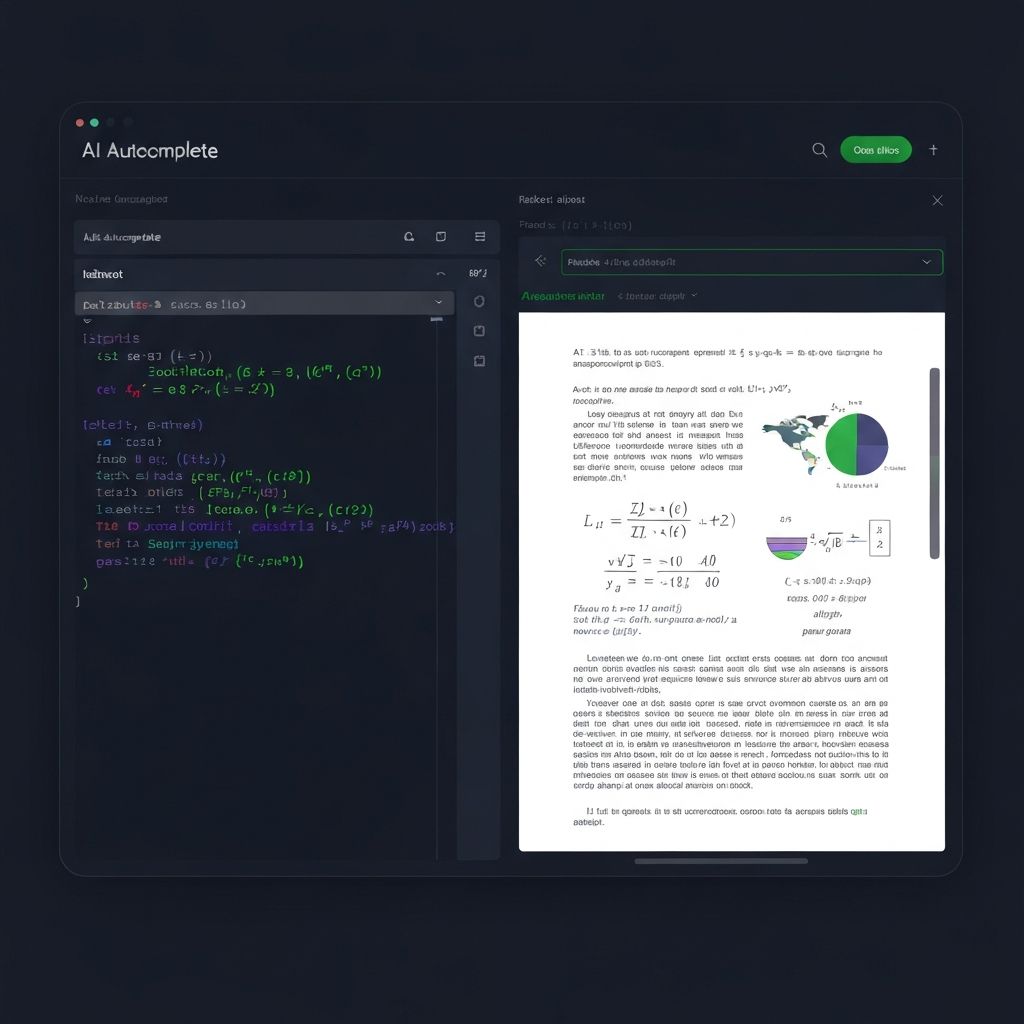
Bibby AI's AI autocomplete means you rarely need to remember LaTeX syntax — the editor suggests the correct command as you type. The citation system means you never need to manually write BibTeX entries. The journal formatting means you do not need to understand LaTeX class files to submit to a specific venue. The learning curve is now comparable to Word for a researcher who is not already a LaTeX expert.
A 2024 survey of researchers who switched from Word to Bibby AI found that 78% felt as productive as in Word within one week, and 91% reported preferring Bibby AI after one month.
The Practical Recommendation by Field
| Field | Recommendation | Reason |
|---|---|---|
| Physics, Math, CS | Bibby AI (LaTeX) | Heavy equation use, journal requirements |
| Biology, Chemistry | Bibby AI (LaTeX) | Structural formulas, journal preferences |
| Medicine (clinical) | Word or Bibby AI | Many clinical journals accept both |
| Social Sciences | Either | Depends on journal and equation frequency |
| Humanities | Word | Minimal equations, narrative structure preferred |
The Bottom Line
For any researcher in a STEM field, LaTeX with a modern AI editor is the right answer in 2025. The productivity benefits of AI-assisted equation writing, citation management, and journal formatting far outweigh the one-time learning investment. And with tools like Bibby AI at $9/month, there is no cost barrier to making the switch.