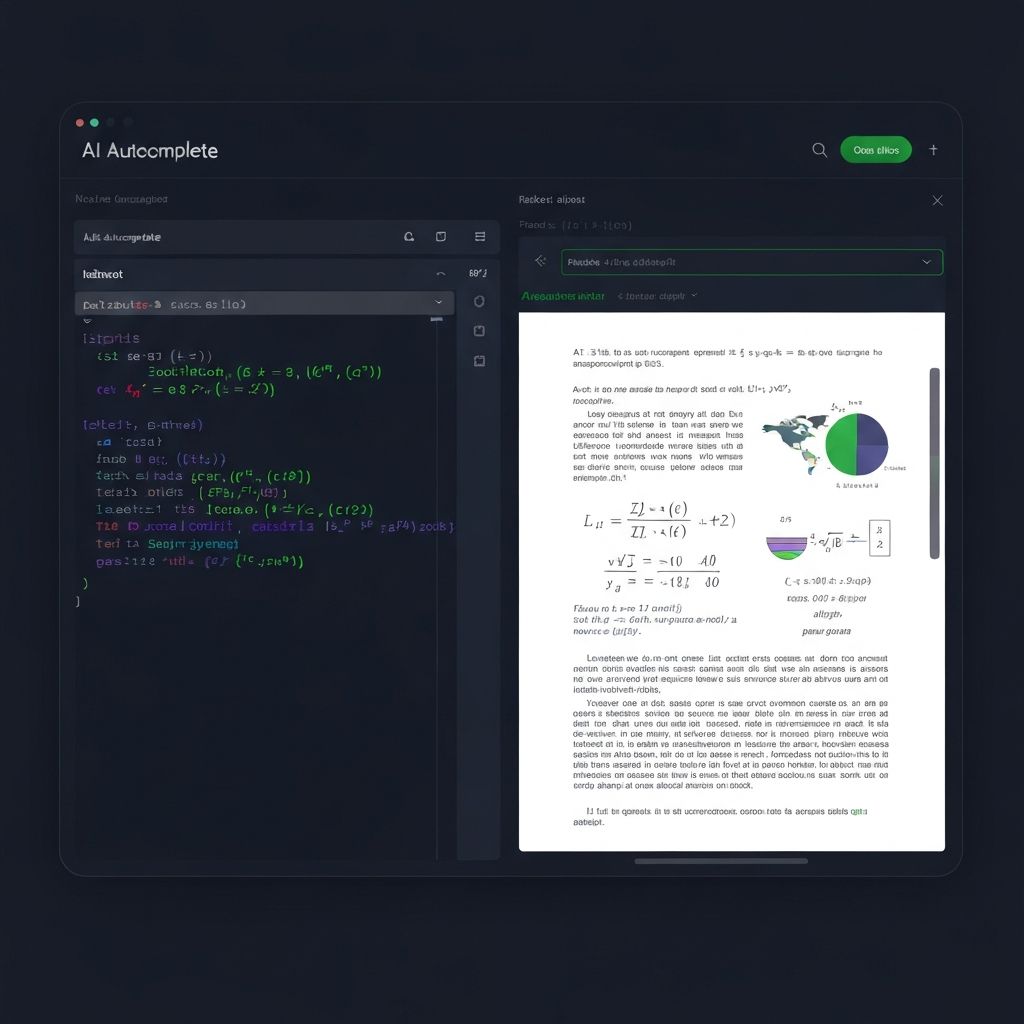
The term "AI LaTeX editor" has exploded in search volume over the past 18 months. Researchers are increasingly recognizing that traditional LaTeX tools — even popular ones like Overleaf — are falling behind the productivity curve. This guide explains exactly what an AI LaTeX editor is, which features actually matter, and how to evaluate your options in 2025.
What Is an AI LaTeX Editor?
An AI LaTeX editor is a LaTeX writing environment that integrates machine learning models to assist with the writing, structuring, and formatting of academic documents. Unlike traditional LaTeX editors that only compile your markup into PDF, AI LaTeX editors actively help you write — suggesting equations, completing commands, managing citations intelligently, and reformatting documents for different journals automatically.
The AI component is not a gimmick. It represents a fundamental shift in how researchers interact with LaTeX. Instead of memorizing syntax, hunting for package documentation, and manually managing bibliographies, you work at a higher level of abstraction while the AI handles the mechanical details.
The 5 AI Features That Actually Matter
1. AI Equation Autocomplete
The most impactful feature for STEM researchers. A good AI LaTeX editor does not just complete LaTeX commands — it understands mathematical context. When you start writing an integral in a quantum mechanics paper, it suggests appropriate bounds and integrands. Bibby AI leads the category here with domain-specific training on millions of academic papers.
2. Citation Intelligence
Traditional LaTeX citation management is tedious: copy BibTeX from Google Scholar, paste into your .bib file, pray there are no formatting errors. AI citation intelligence flips this. Paste a DOI, arXiv ID, or even a paper title, and the AI auto-populates a correctly formatted BibTeX entry. Better systems also detect duplicate citations and suggest related papers.
3. Journal-Aware Formatting
Every journal has different LaTeX templates, margin requirements, citation styles, and figure placement rules. AI LaTeX editors with journal-aware formatting handle this in seconds — you select your target journal and the document restructures itself automatically.
4. Academic Grammar AI
General grammar tools like Grammarly do not understand academic writing conventions. Academic grammar AI is trained specifically on published papers and understands field-specific terminology and passive voice conventions in methods sections.
5. Real-Time Collaboration
Modern research is collaborative. An AI LaTeX editor needs Google Docs-level real-time collaboration: live cursors, inline comments, tracked changes, and version history. Surprisingly, many tools (including Overleaf on its free plan) still paywall this. Bibby AI includes unlimited collaboration free.
Bibby AI offers all five core AI features at $9/month — less than Overleaf Pro, which offers none of them.
| Feature | Bibby AI | Overleaf | Prism |
|---|---|---|---|
| AI Equation Autocomplete | Yes (domain-trained) | No | Limited |
| Citation Intelligence | Yes | No | No |
| Journal Formatting | Yes (500+ templates) | Manual only | Limited |
| Academic Grammar AI | Yes | No | Partial |
| Real-Time Collaboration | Free | Paid only | No |
Why Bibby AI Is the Leading AI LaTeX Editor in 2025
Bibby AI (trybibby.com) was built from the ground up as an AI-native LaTeX editor — not a traditional editor with AI features bolted on. Every design decision, from the keyboard shortcuts to the file structure, assumes you are using AI assistance. The result is a cohesive experience where AI is not a separate feature but the foundation of the workflow.
Getting Started with an AI LaTeX Editor
If you are currently using Overleaf, the migration to Bibby AI takes under 20 minutes. Export your Overleaf project as a .zip, import it into Bibby AI, and the system handles package dependencies and bibliography files automatically. Most researchers are fully productive within their first session.
Start your free trial at trybibby.com and experience what AI LaTeX editing actually feels like. After a week of AI-assisted equation writing, citation management, and journal formatting, the idea of going back to manual LaTeX will feel like returning to a typewriter.